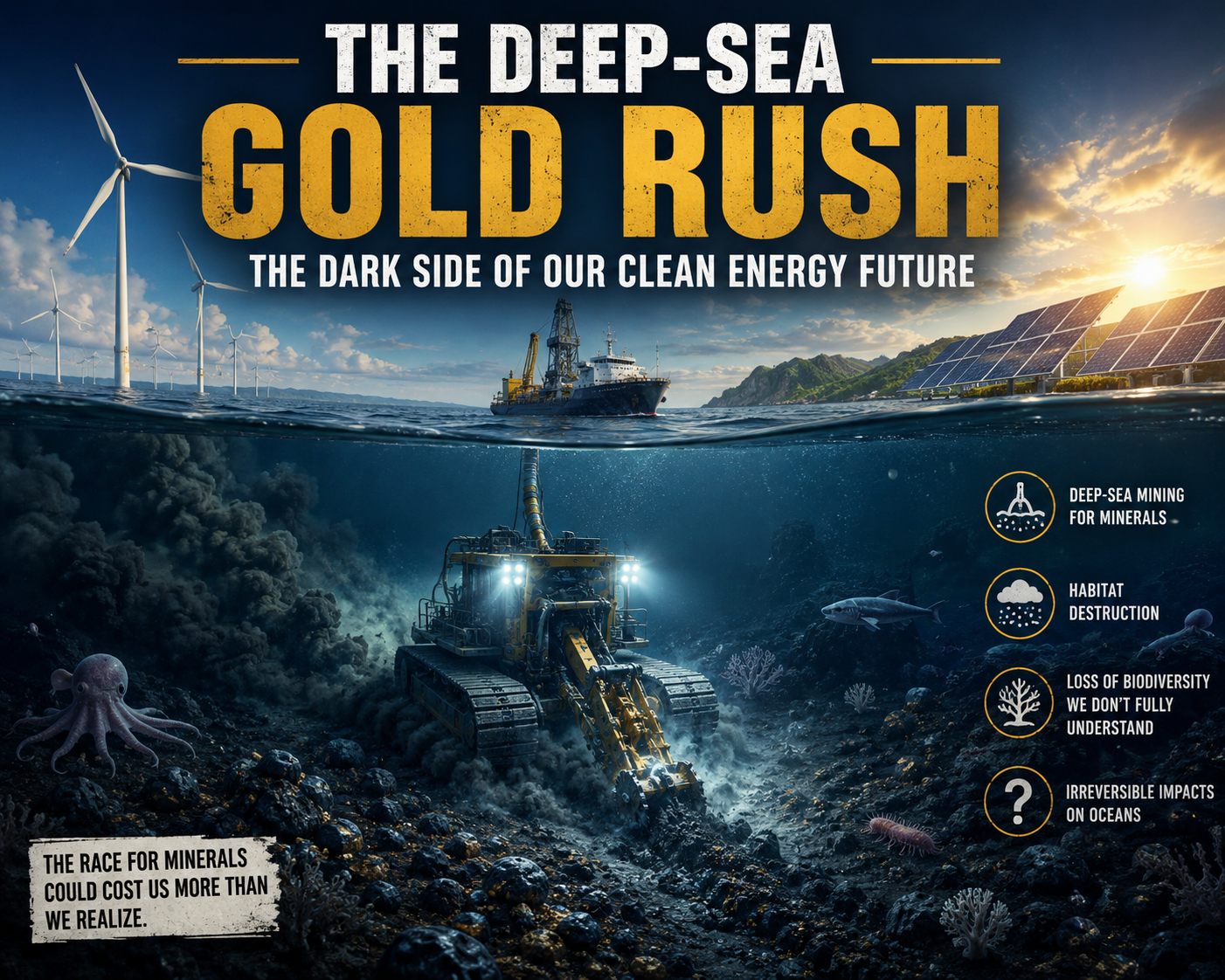
The Deep-Sea Gold Rush: The Dark Side of Our Clean Energy Future
When we think about global conflicts and resource wars, our minds usually go to land borders or oil fields. However, a massive and quiet struggle is kicking off in absolute darkness, miles beneath the ocean surface. To understand this shifting dynamic, we must analyze the emerging deep-sea mining environmental impact, as a modern gold rush begins for the raw materials needed to power our “green” transition away from fossil fuels.
To stop climate change, the world is shifting toward electric vehicles, solar power grid installations, and massive wind turbines. The irony is that this clean energy revolution is incredibly hungry for heavy metals: nickel, cobalt, copper, and manganese. For decades, getting these meant tearing down rainforests or exploiting cheap labor in places like the Democratic Republic of Congo. Now, because land mines are running low and facing heavy social backlash, mining companies are looking at the seabed as their next jackpot.
The Real Prize: What’s at the Bottom?
The main stage for this drama is a massive stretch of the Pacific Ocean between Hawaii and Mexico called the Clarion-Clipperton Zone (CCZ). Down here, at depths of 4,000 meters or more, the water is near freezing, the pressure is immense, and there is zero sunlight. But sitting right on the muddy floor are trillions of blackish, potato-sized rocks known as polymetallic nodules.
These rocks are basically natural battery packs. Over millions of years, dissolved metals in the ocean slowly stuck together to form these nodules. Instead of digging deep underground and processing tons of waste rock, a company can theoretically just scoop these up. They contain a massive concentration of high-grade nickel and cobalt—the exact ingredients companies like Tesla and BYD need for their EV batteries. Some estimates suggest there is more cobalt and nickel down there than in all known land reserves combined.
The Geopolitical Chess Match
Since these resources sit in international waters, no single country can just plant a flag and claim them. Everything goes through a small UN-linked agency called the International Seabed Authority (ISA). The ISA has a tough job: they are supposed to protect the ocean environment but also hand out mining licenses for the “benefit of mankind.”
Behind the scenes, it’s a political mess. China has been playing the long game here, quietly securing multiple exploration contracts and locking down the tech needed for deep-sea extraction. Since China already controls most of the world’s land-based processing for battery metals, Western countries are starting to panic.
The US is at a massive disadvantage because it never ratified the UN Convention on the Law of the Sea. This means American companies can’t apply for mining licenses directly. Instead, Western corporations are backing small island nations, like Nauru, to exploit legal loopholes and force the ISA to fast-track commercial mining.
The Environmental Red Flags
Mining executives love to pitch this as a cleaner alternative to land mining. They claim it doesn’t destroy communities or clear-cut forests. But marine scientists are terrified. The deep ocean floor isn’t a dead wasteland; it’s a highly fragile ecosystem with bizarre creatures that exist nowhere else on Earth, most of which haven’t even been studied yet.
The actual mining process is pretty aggressive. Massive, heavy robotic vehicles will crawl along the seafloor, vacuuming up the nodules and pumping them to a ship on the surface. This creates three major issues:
Destroying Habitats: These nodules are the only hard surfaces in a world of soft mud. Corals, sponges, and anemones need them to survive. If you take the rocks away, the entire ecosystem collapses, and because these rocks take millions of years to grow, the damage is permanent.
Underwater Dust Storms: As these heavy rovers move around, they stir up massive clouds of fine sediment. These underwater dust plumes can travel for miles, choking out marine life that relies on clear water to filter food.
Noise Pollution: The deep ocean is naturally quiet, and marine life uses sound to navigate and communicate. The non-stop roar of heavy machinery operating under high pressure will disrupt whales, dolphins, and deep-diving fish, potentially messing with their basic survival instincts.
The Green Energy Dilemma
This whole situation brings up a massive ethical question: Is it right to ruin an untouched underwater ecosystem just to save our atmosphere? Are we actually creating a green future, or are we just shifting our pollution from the land to the deep sea?
The pro-mining camp says that if we don’t mine the ocean, we are choosing to keep using child labor and cutting down forests on land. But critics point out that battery technology is moving incredibly fast. Many tech companies are already shifting to Lithium Iron Phosphate (LFP) or sodium-ion batteries, which don’t even use cobalt or nickel. If that tech becomes the standard, we might destroy the seafloor for absolutely no reason.
A Critical Crossroads
We are at a rare point in history where we have the technology to exploit a part of the planet before we actually understand it. Recognizing the risks, major brands like Google, BMW, Volvo, and Samsung have already signed a pledge promising not to buy or use deep-sea minerals until the science is clear.
The choices made by international regulators over the next few years are going to set the tone for decades. The race for the deep sea isn’t just about making cheaper batteries; it’s a test of whether humanity can stop repeating its old habits of draining resources without thinking about the long-term consequences.