If you want to take control of your financial future, you need to understand exactly how credit score works. Usually, you only start thinking about it when you desperately need it—like when you are trying to buy a car, applying for a mortgage, or trying to convince a landlord to let you rent a decent apartment. Suddenly, this random three-digit number becomes the single most important thing in your life.
For a lot of people, the credit system feels rigged. It feels like banks have a secret, shadowy file on you and use it to judge your worth. But once you strip away the financial jargon, there is no magic involved. Your credit score is just an adult report card. It is a mathematical formula based entirely on your past behavior with money.
If you want to stop feeling stressed about credit and start using it to your advantage, you need to know exactly how the game is played. Here is the full breakdown of how credit scores actually work, the math behind them, and how to manipulate that math in your favor.
The Difference Between a Credit Report and a Credit Score
Before we look at the numbers, you need to understand where they come from. People often confuse credit reports and credit scores, but they are two different things.
Think of your credit report as your permanent record. There are massive data-collection companies called credit bureaus (in India, the main one is CIBIL; in the US and globally, it’s Experian, Equifax, and TransUnion). Every time you get a credit card, take out a loan, or miss a payment, your lender snitches on you to these bureaus. The bureaus write it all down in a massive, detailed file.
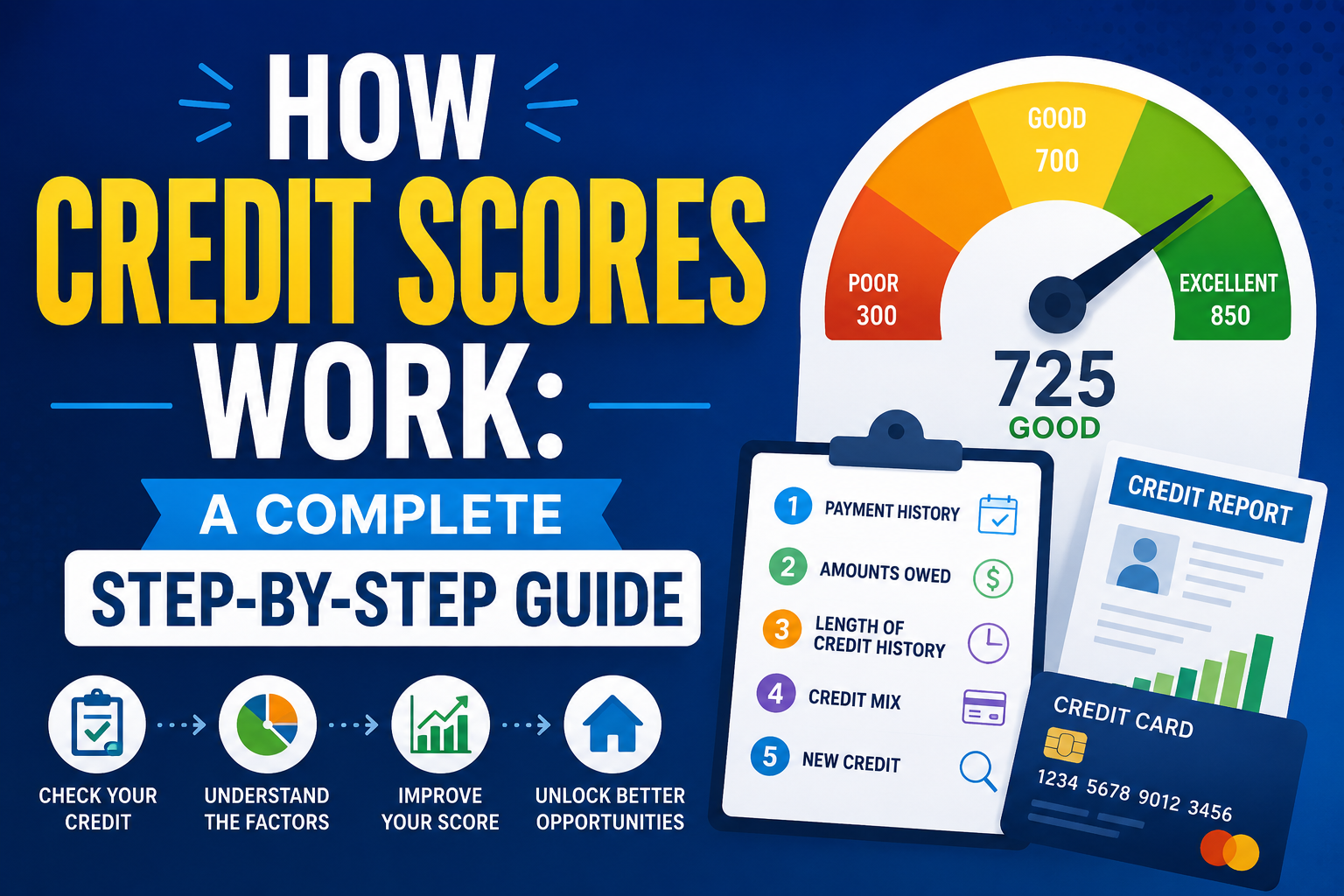
Your credit score is the grade you get based on that file. Companies use scoring algorithms to read your credit report and spit out a three-digit number. This number tells a lender exactly how risky it is to lend you money. The score usually ranges from 300 to 850 (or 900 in some regions).
- 300–599: You are high-risk. Getting a loan will be tough, and if you do get one, the interest rates will be brutal.
- 600–699: You are doing okay, but lenders will still charge you higher interest.
- 700–749: You are in the “good” zone. You’ll get approved for most things with decent rates.
- 750+: You are golden. Lenders will throw money at you at the lowest possible interest rates.

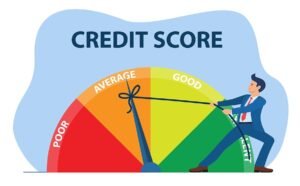
Credit score concept. businessman pulling scale changing credit information from poor to good, excellent. Payment history data meter. Vector illustration in flat style.
The Big Five: How the Math Actually Works
The companies that create these scores don’t publish their exact algorithms, but they don’t hide the ingredients either. Your score is made up of five specific factors. If you want a high score, this is exactly where you need to focus your attention.
1. Payment History (35% of your score)
This is the heavy hitter. More than a third of your score comes down to one simple question: Do you pay your bills on time?
Lenders are paranoid. They want proof that if they give you money, you will give it back exactly when you promised. Consistently paying your credit card bill or loan installment on time builds this part of your score. On the flip side, missing a payment is disastrous. Even a single payment that is 30 days late can tank a great credit score by 50 to 100 points, and that black mark stays on your report for years.
2. Credit Utilization Ratio (30% of your score)
This one confuses a lot of people, but it is just basic division. Your utilization ratio is how much of your available credit you are actually using.
If your credit card has a limit of $10,000, and you spend $3,000 on it, your utilization is 30%. The general rule of thumb is that you should never let your utilization go above 30%. If you max out your credit cards, lenders view you as desperate for cash, which makes you a high risk for defaulting.
Pro Tip: If you have a low credit limit and you constantly hit that 30% threshold, just pay off your balance twice a month instead of waiting for the statement to arrive. The credit bureaus will only see the low balance, and your score will jump.
3. Length of Credit History (15% of your score)
Lenders love long, boring track records. This category looks at how long you have been managing credit. The algorithm looks at your oldest account, your newest account, and the average age of all your accounts combined.
This is exactly why you should almost never close your first credit card. Let’s say you have had a basic credit card for ten years. You decide you don’t need it anymore and close the account. Overnight, you wipe out a decade of good credit history. Your average account age drops, and your score takes a hit. Put a small subscription like Netflix on your oldest card, set it to autopay, and throw the physical card in a drawer. Keep it alive.
4. Credit Mix (10% of your score)
Lenders want to see that you know how to handle different types of debt, not just a bunch of credit cards. They look for a mix of “revolving” credit (like credit cards, where the balance changes) and “installment” loans (like a car loan or student loan, where you pay a fixed amount every month).
Honestly, this is a minor factor. You should never take out a loan and pay interest just to improve your credit mix. It will happen naturally over time as you go through life.
5. New Credit and Hard Inquiries (10% of your score)
Every time you apply for a new loan or credit card, the bank pulls your credit report to check your history. This is called a “hard inquiry,” and it temporarily knocks a few points off your score.
If you apply for one credit card, it’s not a big deal. The points bounce back in a few months. But if you apply for five credit cards and a personal loan in the span of three weeks, you look erratic and desperate for money. Space out your credit applications by at least six months.
Busting the Biggest Credit Myths
There is a lot of terrible financial advice floating around the internet. Let’s kill a few of the biggest myths right now.
- Myth 1: “Checking my own score will lower it.” Absolutely false. When you check your own credit score on an app or website, it is called a “soft pull.” You can check it every single day if you want to, and it will never affect your score.
- Myth 2: “I need to carry a small balance to build credit.” This is the most expensive lie in personal finance. You do not need to pay a penny in interest to build a perfect credit score. Pay your statement balance in full every single month. Your score will climb just as fast, and you get to keep your money.
- Myth 3: “My income affects my credit score.” Your salary, your job title, and the amount of money in your bank account have zero impact on your credit score. You could make a million dollars a year, but if you constantly forget to pay your credit card bill, your score will be garbage.
How to Fix a Trashed Score
If you are looking at a bad score right now, don’t panic. You aren’t stuck with it forever. The fastest way to fix it is to get hyper-consistent.
First, automate all of your minimum payments so you never miss a due date again. Second, aggressively pay down your existing balances to get your utilization under that magic 30% mark. Finally, pull a free copy of your actual credit report and look for mistakes. Credit bureaus screw up all the time. If you find a late payment you didn’t actually miss, or an account you don’t recognize, dispute it. If they can’t prove it’s yours, they have to delete it by law, which will give your score an instant boost.
Your credit score isn’t a judgment of your character. It’s just a tool. Treat the rules with respect, pay your bills, and let the math do the hard work for you.
Disclaimer :
Educational Purposes Only: This article and all information contained within it are provided for educational and informational purposes only.