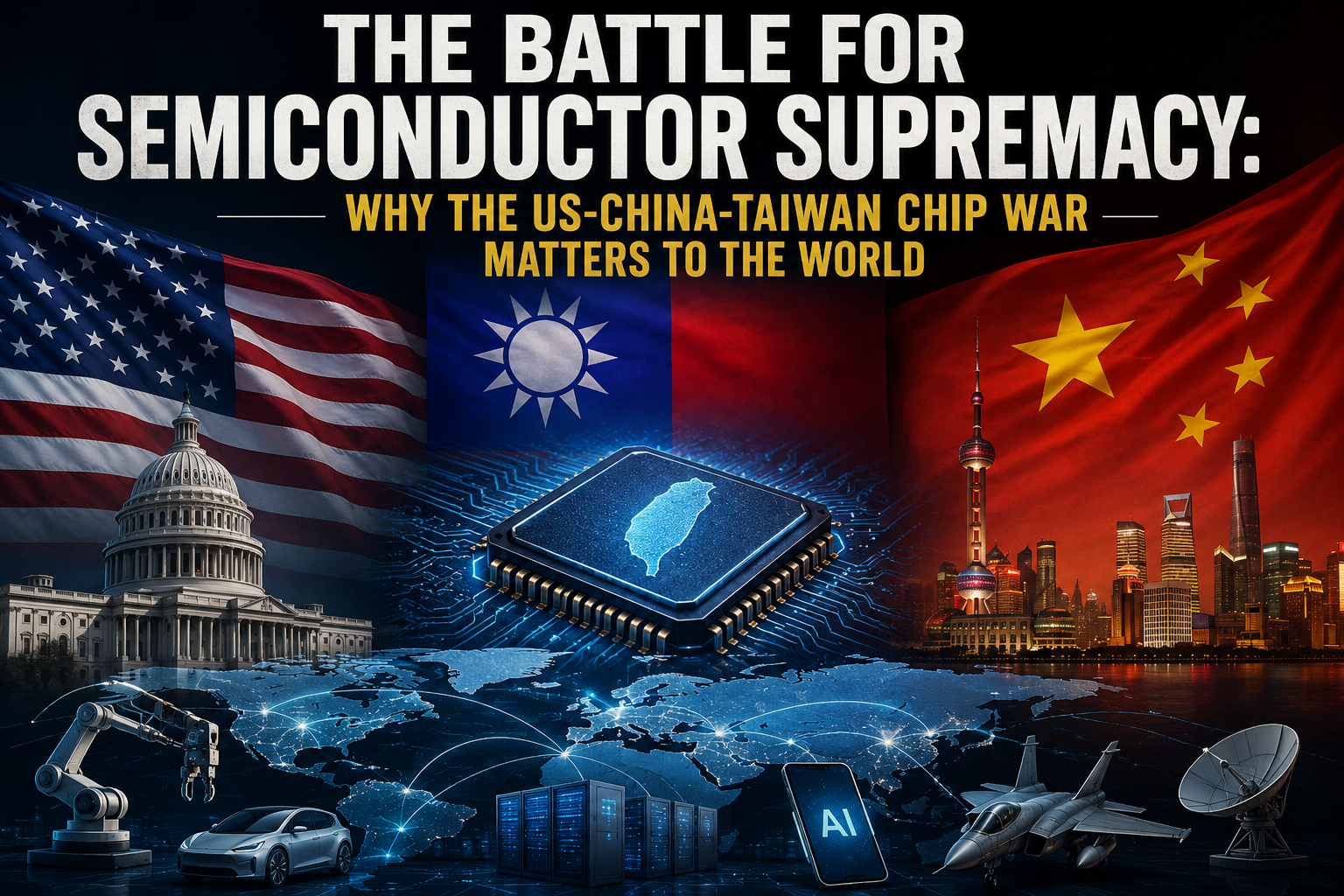
The Battle for Semiconductor Supremacy: Why the US-China-Taiwan Chip War Matters to the World
Go back a few decades, and global power boiled down to a single commodity: crude oil. In 2026, the world’s most fiercely contested resource isn’t liquid gold pumped from the desert—it’s a microscopic sliver of silicon, fueling the global semiconductor chip war. The nations pulling the levers of the world economy were the ones controlling the pipelines. But look around today. The geopolitical chessboard has completely flipped. In 2026, the world’s most fiercely contested resource isn’t liquid gold pumped from the desert—it’s a microscopic sliver of silicon.
Microchips are the invisible backbone of modern life. They power the smartphone sitting on your desk, navigate the electric vehicle in your driveway, steer hypersonic defense missiles, and keep massive artificial intelligence data centers breathing. As generative AI continues its relentless march across every industry, the global semiconductor market is on a fast track toward a staggering $1 trillion valuation.
Because these tiny chips dictate both military dominance and economic survival, they’ve sparked a quiet, brutal war. The ongoing struggle between Washington and Beijing—with Taiwan trapped squarely in the crosshairs—isn’t just another corporate rivalry. It’s a high-stakes clash of superpowers that will decide who owns the future.
Taiwan and TSMC: The World’s Unlikely “Silicon Shield”
To understand why the world is on edge, you have to look at Taiwan, a small island nation constantly staring down the shadow of mainland China. Taiwan produces roughly 60% of the world’s microchips. Even more staggering? It manufactures over 90% of the ultra-advanced, hyper-fast processors (anything under 7 nanometers) that run our most sophisticated tech.
At the absolute center of this monopoly is one company: TSMC (Taiwan Semiconductor Manufacturing Company). It is, without exaggeration, the most geopolitically critical corporation on the planet. TSMC runs massive, highly secretive fabrication facilities, known as “fabs,” that no other country has been able to clone. Tech titans like Apple, Nvidia, and AMD—and even the US military—simply cannot function without them.
This has created what political scientists call Taiwan’s “Silicon Shield.” The idea is simple: Taiwan’s chip factories are so indispensable that a military conflict there would instantly plunge the global economy into a dark age. Therefore, the US and its Western allies have every reason to defend the island, turning microchips into a powerful deterrent against invasion.
US vs. China: A No-Holds-Barred Tech Rivalry
America actually invented the semiconductor, but over the years, US companies outsourced the messy, expensive business of physical manufacturing to Asia. While Silicon Valley still excels at designing the brains of computers, America’s reliance on foreign factories has left Washington deeply rattled.
Now, the US government is playing hardball with a two-step strategy to freeze China out:
The Iron Curtain of Exports: Washington has slapped aggressive restrictions on shipping high-end AI chips and advanced chip-making machinery to Chinese shores. The explicit goal? Slow down Beijing’s military AI capabilities.
Bringing the Factories Home: Through the CHIPS Act, the US is throwing billions of dollars at companies to build cutting-edge manufacturing plants on American soil.
Beijing, however, isn’t taking this sitting down. Viewing these bans as an existential threat to its economic rise, China is pouring hundreds of billions into a frantic race for semiconductor self-sufficiency. While they still lag behind in printing the ultra-tiny 2nm chips, they have aggressively cornered the market on “legacy chips”—the older, mature semiconductors that keep everything from your microwave to medical equipment running. On top of that, China has begun choking off the global supply of Gallium and Germanium, the rare-earth materials without which electronic manufacturing grinds to a halt.
Nvidia and the AI Gold Rush: Fueling the Fire
If the chip war was a slow burn before, the sudden explosion of Generative AI turned it into a raging wildfire. Training massive AI models requires an insane amount of raw computing power, and that power belongs almost exclusively to one company: Nvidia.
Nvidia’s high-end graphics processing units (GPUs) are the undisputed gold standard of the AI revolution, and they are built exclusively by TSMC in Taiwan. Because artificial intelligence is now viewed as the ultimate weapon for future cyberwarfare, national intelligence, and corporate dominance, these chips are being hoarded like gold during a crisis. Whoever controls the physical factories printing these GPUs essentially controls the speed of human innovation.
The Fallout: How This Conflict Hits Your Wallet
It’s easy to tune out global geopolitics when it feels like a distant corporate chess match. But a sudden freeze in the semiconductor supply chain would hit the average consumer hard and fast. If things boil over in the Taiwan Strait, the ripple effects will be felt globally:
1. Skyrocketing Tech Prices
If TSMC’s factories go offline, the supply of smartphones, laptops, and smart TVs will instantly dry up. With millions of buyers fighting over dwindling stock, retail prices for everyday electronics would explode overnight.
2. A Freeze on Car Manufacturing
Today’s vehicles are basically computers wrapped in steel, packed with hundreds of microchips managing everything from airbags to infotainment systems. A severe chip shortage would freeze automotive assembly lines globally, sending the price of both new and used cars through the roof.
3. A Trillion-Dollar Market Meltdown
The global stock market relies heavily on tech giants. Companies like Apple, Microsoft, and Nvidia represent trillions of dollars in market value. A sudden halt in chip production would trigger a massive panic on Wall Street, wiping out investments and sparking a severe global recession.
Conclusion: The New World Order is Cast in Silicon
The battle for the microchip is radically rewriting the rules of global trade and international diplomacy. It proves that in the 21st century, superpower status isn’t just measured by the size of a country’s nuclear arsenal, but by the nanometer precision of its technology.
While America tries to build domestic fortresses for manufacturing and China pushes hard for self-reliance, the global economy remains profoundly dependent on a fragile peace in Taiwan. In this ruthless race, one reality is crystal clear: the nation that rules the semiconductor supply chain will ultimately dictate the economic and technological future of the world.