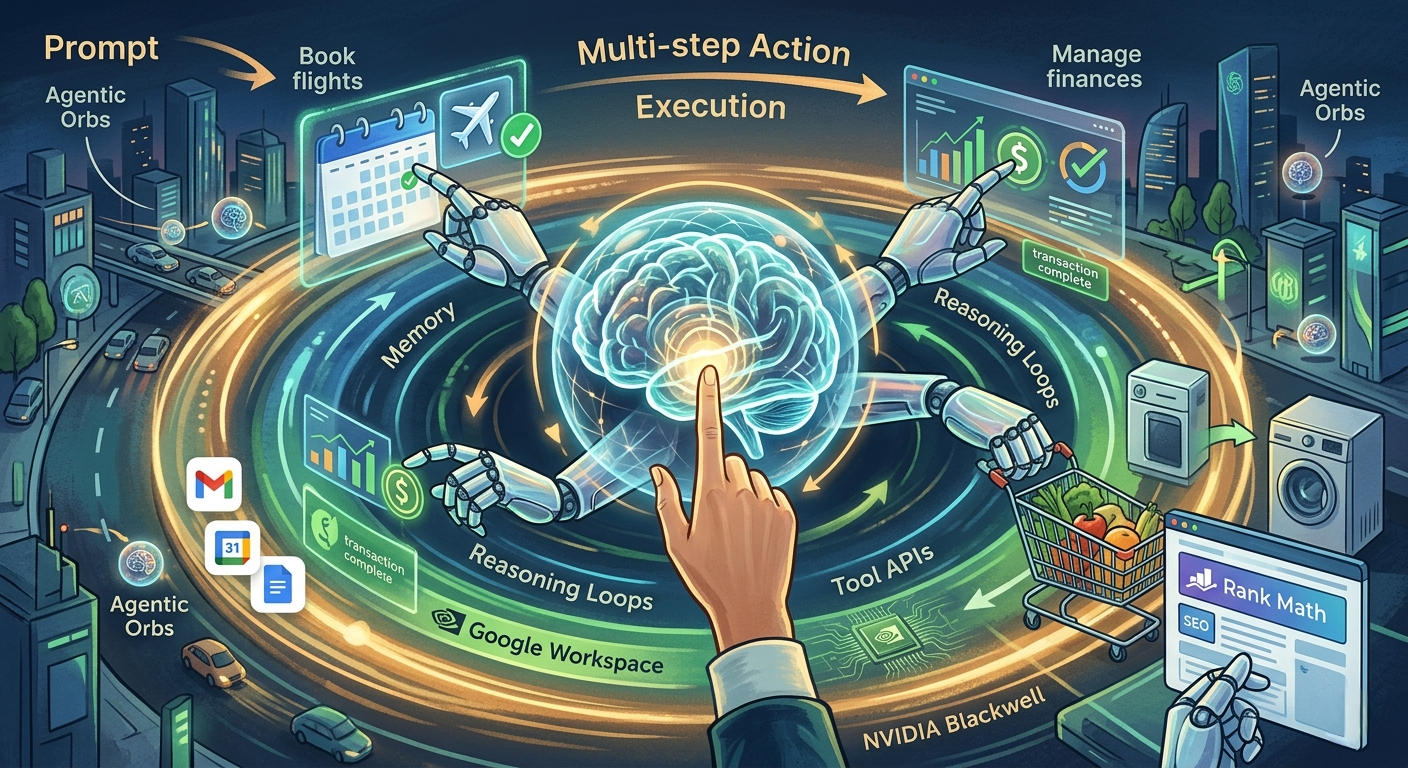
Beyond Chatbots: How Agentic AI is Quietly Taking Over the Digital World
For the last two years, the world has been obsessed with Generative AI. We marveled at how ChatGPT could write poems and how Midjourney could paint landscapes. But as the “novelty” wears off, a more potent and transformative technology is emerging from the labs of Google, OpenAI, and NVIDIA.
It is called Agentic AI.
If Generative AI was the “brain” that could think and talk, Agentic AI is the “hands” that can actually do the work. We are moving away from chatbots that give us recipes and moving toward AI Agents that can order the groceries, cook the meal (via smart appliances), and manage the kitchen inventory.
What Exactly is Agentic AI?
To understand Agentic AI, we have to look at the limitation of current LLMs (Large Language Models). Most AI today is passive. You give it a prompt, it gives you a response, and the interaction ends.
Agentic AI is proactive. It is characterized by “agency”—the ability to perceive an environment, reason through a multi-step goal, and take independent actions to achieve it.
Instead of saying, “Write me a travel itinerary for Tokyo,” an Agentic AI system would be told, “Book me a 5-day trip to Tokyo within a $3,000 budget, considering my loyalty points with Marriott and my preference for window seats.” The agent doesn’t just write the plan; it logs into APIs, checks real-time flight data, compares prices, and executes the transaction.
The Core Architecture: Reasoning, Memory, and Tools
A human-written perspective on this tech reveals three pillars that make “agents” different from “chatbots”:
- Iterative Reasoning: Unlike a standard GPT that predicts the next word, an agent uses “Chain of Thought” processing. It creates a plan, realizes when a step has failed, and corrects its own course.
- Dynamic Memory: Agents maintain “long-term memory” of user preferences. They don’t just remember the current chat; they understand your historical behavior across different platforms.
- Tool Use (Function Calling): This is the game-changer. Agents are given “keys” to other software. They can use a calculator, browse a live web page, or execute Python code to solve a complex math problem.
Why the Tech Giants are Pivoting
The shift toward Agentic AI isn’t accidental—it’s a survival tactic for the biggest names in tech.
- Google’s Integration: Google is uniquely positioned because of its ecosystem. An “Agentic Gemini” doesn’t just exist in a chat box; it lives in your Calendar, Gmail, and Docs. It can see you have a meeting at 2 PM, realize you’re running late via Maps, and autonomously draft a professional apology to the attendees.
- NVIDIA’s Hardware Backbone: Running agents requires massive compute power because the AI is “thinking” constantly in the background. NVIDIA’s Blackwell chips are being designed specifically to handle these persistent, “always-on” reasoning loops.
The Impact on the Job Market: Replacement or Augmentation?
The biggest question for any blogger or professional is: Will this take my job?
The reality is nuanced. Agentic AI will likely eliminate “middle-man” tasks. If your job consists of moving data from one spreadsheet to another or coordinating schedules, the risk is high. However, for creators and strategists, agents act as a Force Multiplier.
Imagine a solo entrepreneur. Instead of hiring a virtual assistant, a social media manager, and a bookkeeper, they manage three specialized AI Agents. The human moves from being a “worker” to being a “Director.”
The Dark Side: Security and “Hallucination in Action”
We cannot discuss Agentic AI without addressing the risks. When an AI can take actions—like sending money or deleting files—the cost of a “hallucination” (the AI making a mistake) goes from being funny to being catastrophic.
- The Prompt Injection Threat: If an agent is reading your emails and sees a malicious prompt from a hacker, it might be tricked into forwarding your private data.
- Autonomous Drift: If an agent is given a vague goal, it might take a path that is technically correct but ethically or financially wrong.
SEO and the Future of the Web
For website owners and SEO experts using tools like Rank Math, Agentic AI changes everything. If agents are doing the browsing for users, “clicks” to websites might decrease. However, “conversions” might increase because the agent is bringing a user who is ready to buy.
Optimization will move away from “keywords” and toward “Actionable Structured Data.” You won’t just be optimizing for a human to read; you’ll be optimizing for an AI Agent to “use” your site’s services.
Conclusion: The 2026 Turning Point
As we move through 2026, the distinction between “software” and “employee” will continue to blur. Agentic AI is the realization of the promise made by the original inventors of the computer: a machine that doesn’t just calculate, but assists.
The winners of this era won’t be those who fear the agents, but those who learn to orchestrate them. Whether you are a coder, a blogger, or a business owner, your new “soft skill” is Agent Management.