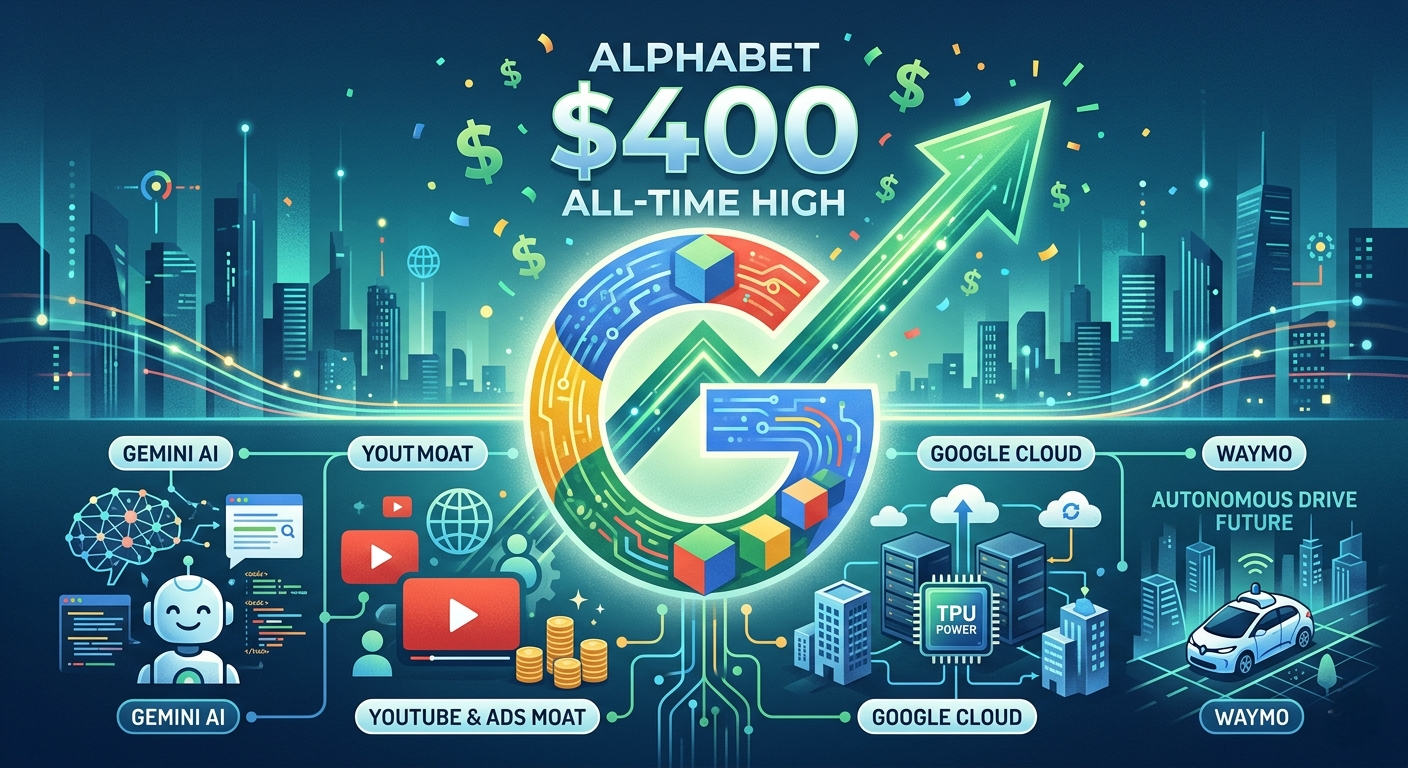
Google’s $400 Surge: Why the Tech King is Finally Back on Top
Not long ago, the tech world was ready to write Google’s obituary. Recently, the Alphabet Stock Price $400 milestone has shaken the financial world… When ChatGPT burst onto the scene, the narrative was everywhere: “Google is the new Blockbuster,” “Search is dead,” and “The giant has fallen asleep at the wheel.”
But fast forward to today, and Alphabet’s stock hitting a historic $400 mark has effectively silenced the critics. It turns out, rumors of Google’s demise were not just premature—they were completely wrong.
The “Gemini” Pivot
The real story here is how Google moved from panic to power. For a year, they looked rattled. However, by aggressively weaving their Gemini AI into everything from Gmail to the search bar we use a thousand times a day, they’ve pulled off a massive pivot.
Instead of AI killing Google Search, it actually made it stickier. People aren’t ditching Google; they are using it more because it’s becoming an all-in-one assistant. For investors, this was the “green light” they needed to see that Google could survive—and dominate—the AI era.
The Cloud Jackpot
While everyone is obsessed with chatbots, the real heavy lifting is happening in Google Cloud. For years, it was a money-loser that sat in the shadow of Amazon and Microsoft. That era is over.
Google Cloud has matured into a profit-generating beast. Because Google designs its own specialized AI chips (TPUs), they have a massive home-court advantage. Companies that want to build their own AI don’t just want software; they need the hardware and the pipes that Google has spent a decade building. This isn’t just a search engine company anymore—it’s the infrastructure for the next century.
Wall Street is All In
There’s a reason big banks like Goldman Sachs and JPMorgan are keeping their “Strong Buy” ratings even at record prices. Google is sitting on a mountain of cash that allows them to outspend almost anyone else on earth. Plus, projects like Waymo (their self-driving car division) are finally moving from science fiction to actual commercial reality on city streets.
1. The Hardware Advantage: Why Google Isn’t Just a Software Company
One of the most overlooked parts of Google’s $400 surge is their hardware. While the world was panicking about Nvidia’s chip shortage, Google was sitting pretty. Why? Because they’ve been designing their own TPUs (Tensor Processing Units) for years.
- The Point: They don’t have to wait in line for chips like everyone else. This vertical integration—owning both the “brain” (AI) and the “body” (the chips)—is a massive cost-saver that Wall Street is finally pricing into the stock.
2. YouTube: The Undisputed King of Attention
We talk a lot about TikTok, but YouTube is still the gold mine. It’s the only platform where creators can actually build a 20-year career.
- The Point: With the rollout of AI-powered dubbing and editing tools, Google is making it easier for a creator in India to go viral in the US. More content means more eyeballs, and more eyeballs mean more ad revenue. YouTube isn’t just a video site; it’s the world’s second-largest search engine, and its “moat” is deeper than ever.
3. Waymo and the “Robotaxi” Revolution
If you want to talk about the future, you have to talk about Waymo. While other car companies are struggling with self-driving tech, Waymo is already operating 24/7 in cities like Phoenix and San Francisco.
- The Point: Analysts estimate that the autonomous vehicle market could be worth trillions. Google is currently the frontrunner. We are moving toward a world where Google doesn’t just navigate your drive; they are the driver.
4. The “Android” Distribution Power
Microsoft has Windows, but Google has the world’s pockets. With over 3 billion active Android devices, Google has a “distribution hack.”
- The Point: When Google drops a new AI feature, they don’t have to ask for permission. They just update the OS, and suddenly, billions of people are using Gemini. This instant scale is something that startups like OpenAI can only dream of.
5. Facing the Giants: The Regulatory War
To keep the article balanced and “human-written,” you must mention the risks. Google is currently fighting massive antitrust battles in the US and Europe.
- The Point: The government wants to know if Google is too big. While this sounds scary, many investors actually think that even if Google were broken up into smaller companies (like YouTube, Search, and Cloud), the individual parts might actually be worth more than the whole.
The Bottom Line
Is there risk? Of course. Regulators are still breathing down their necks with antitrust lawsuits, and the competition is fiercer than ever.
But at $400, the market is sending a clear message: Google didn’t miss the AI revolution. They were just busy building the engine that’s going to run it. If you’re watching the tech space, the takeaway is simple—don’t bet against the company that owns the internet’s front door.