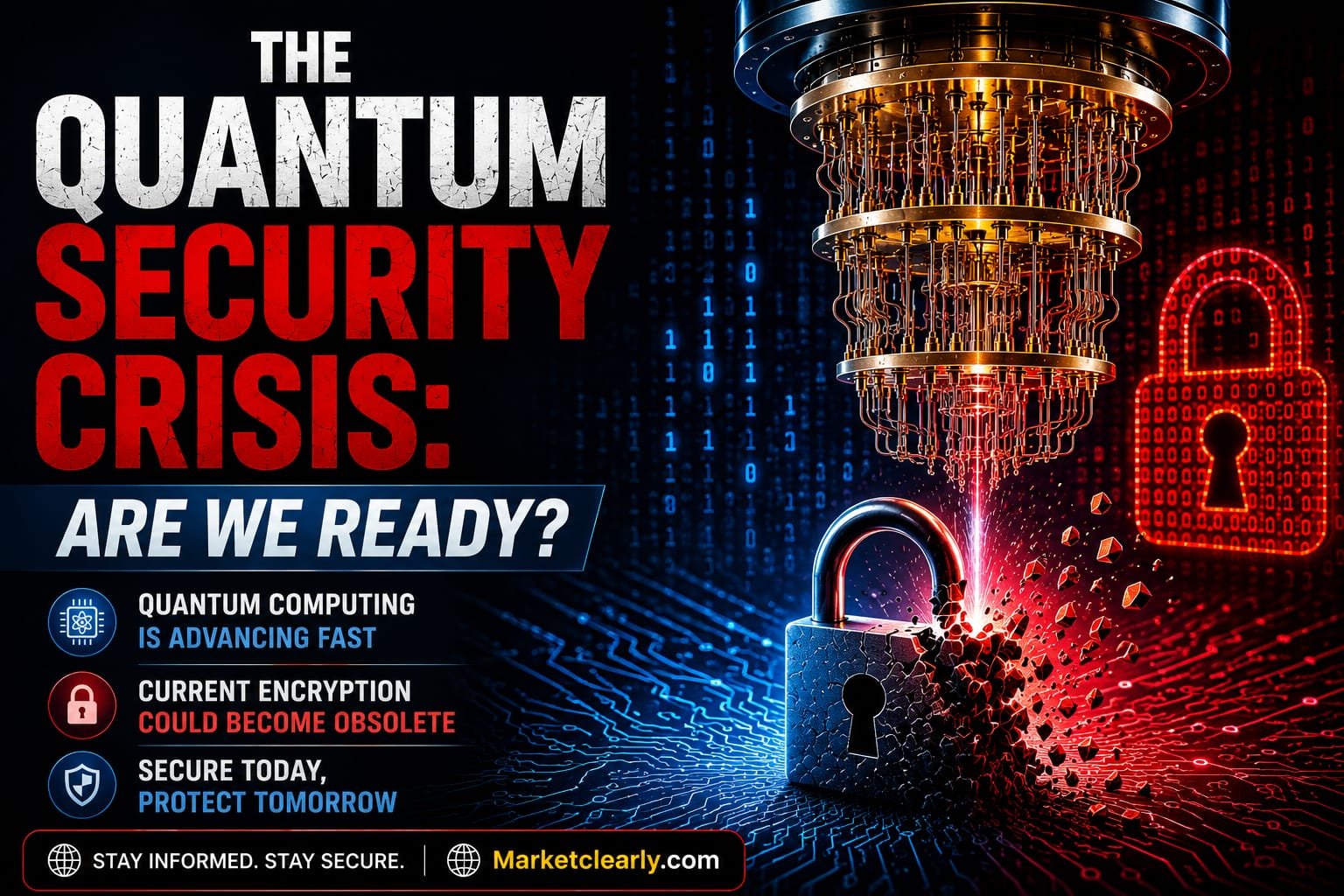
The Quantum Apocalypse: Why Your Digital Life is a Time Bomb (And How PQC Is the Fuse)
In the rapidly evolving world of cybersecurity, Post-Quantum Cryptography (PQC) has emerged as the most critical defense against future quantum threats. In the quiet corridors of research labs in Silicon Valley and Zurich, a silent countdown has begun. It isn’t about a viral pandemic or a global financial crash—at least, not directly. It’s about a date known among cryptographers as “Q-Day.”
This is the day when a quantum computer becomes powerful enough to crack the encryption that currently protects every bit of our digital existence. From your private WhatsApp chats and bank credentials to top-secret government intelligence and the private keys holding trillions in Bitcoin—everything is at risk. But as the threat looms, a new hero is emerging: Post-Quantum Cryptography (PQC).
The Illusion of Digital Safety
To understand the fix, we first have to understand why we are “broken.” For the last few decades, the world has relied on mathematical problems that are easy to do in one direction but nearly impossible to reverse. Think of it like a massive digital jigsaw puzzle with trillions of pieces. A standard supercomputer would take billions of years to solve it. This is the foundation of RSA and ECC encryption—the invisible shields of the internet.
Enter the Quantum Computer. Unlike your laptop, which thinks in 1s and 0s (bits), a quantum computer uses qubits. Thanks to a phenomenon called superposition, it can explore millions of solutions simultaneously. What takes a modern supercomputer a millennium to solve, a mature quantum computer could theoretically crack in seconds.
Suddenly, the “unbreakable” shield looks like a paper curtain.
The “Harvest Now, Decrypt Later” Strategy
You might think, “Why worry now? Reliable quantum computers are still years away.”
This is where things get chilling. State-sponsored hackers and intelligence agencies are currently engaging in a strategy known as SNDL (Store Now, Decrypt Later). They are vacuuming up vast amounts of encrypted data today—even though they can’t read it yet. They are betting on the fact that in 5, 10, or 15 years, they will have the quantum power to unlock it.
If you are a government with diplomatic secrets or a corporation with trade secrets that need to remain classified for 20 years, you are already exposed. The breach hasn’t happened yet, but the data is already in the “enemy’s” hands, waiting for the key to be forged.
Enter Post-Quantum Cryptography (PQC)
If quantum computers are the “ultimate lockpick,” then Post-Quantum Cryptography is the “new lock.”
Contrary to popular belief, PQC isn’t about using quantum physics to protect data (that’s Quantum Key Distribution). Instead, PQC is about creating new mathematical problems that are so complex and “weird” that even a quantum computer gets confused.
The industry is currently gravitating toward Lattice-based Cryptography. Imagine a multidimensional grid with billions of points. Finding a specific point in this “lattice” is a math problem that even quantum Shor’s Algorithm (the famous quantum “cheat code”) can’t solve efficiently. It’s like trying to find a specific grain of sand in a desert that exists in 500 dimensions.
The Global Race for a New Standard
We are currently in the middle of a massive global migration. In 2024 and 2025, the National Institute of Standards and Technology (NIST) finalized the first set of “Quantum-Resistant” algorithms. These aren’t just academic exercises; they are being baked into the very fabric of the internet as we speak.
Companies like Google and Cloudflare have already started implementing “Hybrid” encryption. When you visit certain websites today, your browser is already testing PQC. They use a mix of old encryption (for speed) and new PQC (for future-proofing).
But the migration is a nightmare for older industries. Think about a satellite in space or an underground power grid controller. These devices were built to last 30 years and have very little processing power. Updating them to handle the complex “heavy math” of PQC is one of the biggest engineering challenges of the 2020s.
The Financial Fallout: Crypto and Banking
For the financial world, the stakes couldn’t be higher.
- The Crypto Crisis: Most cryptocurrencies, including Bitcoin and Ethereum, use Elliptic Curve Digital Signature Algorithm (ECDSA). A quantum computer could easily derive a private key from a public address. If the crypto world doesn’t migrate to “Quantum-Resistant” signatures soon, the entire trust in blockchain could evaporate. We are already seeing “Quantum-Safe” blockchains being developed, but the “Old Gold” (Bitcoin) will eventually face a “hard fork” or die.
- The Stock Market & Defense: Companies like NVIDIA are at the center of this. They aren’t just building chips for AI; they are building the hardware that will run these incredibly heavy PQC algorithms. Investors are starting to realize that “Quantum Security” is a trillion-dollar industry. If you aren’t quantum-secure, you aren’t “investable.”
Why This Isn’t Just “Another Y2K”
Some critics compare the Quantum Threat to the Y2K bug—a lot of hype that resulted in nothing. But that’s a dangerous misunderstanding. Y2K was a software glitch with a fixed deadline. The Quantum threat is a fundamental shift in the laws of computation.
It’s more like the invention of gunpowder in the age of swords. No matter how sharp your sword (current encryption) is, it simply cannot compete with the new physics of the battlefield.
The Human Element: Why Privacy Matters
At the end of the day, PQC isn’t about math; it’s about human rights. In a world where our thoughts, medical records, and relationships are digitized, encryption is the only thing that guarantees our autonomy.
If a totalitarian regime gets a quantum computer before the world finishes the PQC migration, privacy as we know it will cease to exist. Every whistleblower, every journalist, and every private citizen becomes an open book. This is why the push for PQC is perhaps the most important “invisible” fight of our generation.
Conclusion: A World Re-Coded
The transition to Post-Quantum Cryptography is going to be slow, expensive, and technically exhausting. We are essentially re-wiring the entire global internet while it’s still running.
However, it is a necessary evolution. As we move further into the age of AI and high-speed data, our locks must get stronger. The “Quantum Apocalypse” doesn’t have to be an ending; it can be the beginning of a truly secure digital era—one where our data is safe not just for today, but for a century to come.
For bloggers, investors, and tech enthusiasts, the message is clear: Stop looking at what’s on the screen, and start looking at how the screen is protected. The quantum future is coming, and it’s time to change the locks.